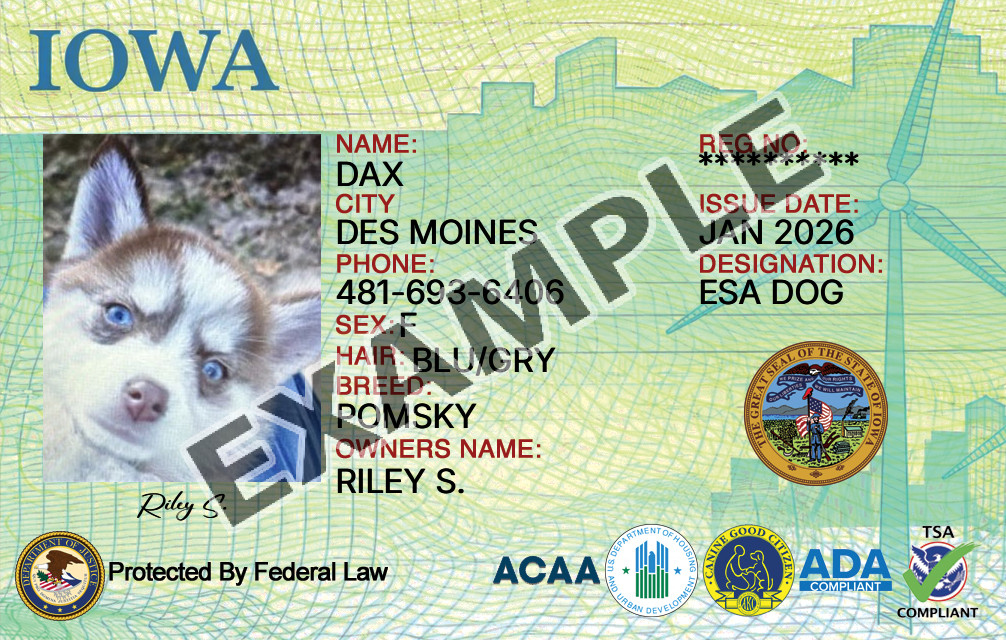
If you’re asking “where do I register my dog in Iowa for my service dog or emotional support dog”, the answer usually involves two separate tracks: (1) getting a dog license in Iowa (often tied to rabies vaccination and handled by your city, county animal control, or sheriff/police department), and (2) understanding the legal status of a service dog versus an emotional support animal (ESA). In most cases, there is no statewide “service dog registry” required to make a dog a service dog or ESA—but your community may still require a standard pet license.
Where to Register or License Your Dog in Iowa
Because rules and payment methods vary by city and county, below are examples of official local offices that handle pet licensing, rabies tag programs, or animal control administration. Use these as models to identify the correct office for your address when you’re figuring out where to register a dog in Iowa.
Example City Office (West Des Moines)
| Office name | City of West Des Moines – Finance Department (Dog & Cat Licenses) |
|---|---|
| Street address | 4200 Mills Civic Parkway |
| City / State / ZIP | West Des Moines, IA 50265 |
| Phone | (515) 222-3600 |
| PetLicense@wdm.iowa.gov | |
| Office hours | Not listed in the source consulted |
Example City Office (Waukee)
| Office name | City of Waukee – City Clerk’s Office (Pet Licensing) |
|---|---|
| Street address | 230 W Hickman Road |
| City / State / ZIP | Waukee, IA 50263 |
| Phone | (515) 978-7904 |
| Not listed in the source consulted | |
| Office hours | Not listed in the source consulted |
Example County Office (Linn County Public Service Center)
| Office name | Linn County Treasurer’s Office / Motor Vehicle Department (Public Service Center) |
|---|---|
| Street address | 935 2nd Street SW |
| City / State / ZIP | Cedar Rapids, IA 52404 |
| Phone | (319) 892-5500 |
| Not listed in the source consulted | |
| Office hours | Monday–Friday 7:30 a.m.–5:15 p.m. |
How to find the right office for your address
- If you live inside city limits, check your city’s website for “pet license,” “dog license,” or “animal control.”
- If you live in an unincorporated area, check your county (often sheriff, animal services, public health, or treasurer).
- If you’re still not sure, call your city clerk or county sheriff non-emergency line and ask who administers the licensing program.
Overview of Dog Licensing in Iowa
Dog licensing is local, not a single statewide registry
Iowa does not operate one universal, statewide “pet registration” counter for all residents. Instead, a dog license in Iowa is typically issued by your city (for example, a city finance department, city clerk, or police department) or by a county program (often tied to animal services or a rabies tag program). That’s why the most accurate answer to “where do I register a dog in Iowa” is: the office that serves your exact home address.
Why licensing exists (and why it still matters for service dogs and ESAs)
Local licensing programs are usually designed to:
- confirm your dog is currently vaccinated for rabies (a key public health requirement),
- create a clear ownership record if your dog is found,
- support animal control and shelter operations in many communities, and
- standardize identification through tags.
Even if your dog is a service dog or an emotional support animal, you may still need the same local license required of any other dog living in the city or county.
How Dog Licensing Works Locally in Iowa
Step 1: Confirm the correct jurisdiction (city vs. county)
The first step is determining who issues the license where you live:
If you live inside a city
Look for your city’s pet licensing page. In some places, licensing is managed by a finance department or city clerk; in others, it may be handled through the police department or contracted animal control.
If you live outside city limits
Check your county’s animal services, sheriff’s office, public health, or treasurer resources. Some counties run a rabies license/tag program tied directly to animal control services.
Step 2: Rabies vaccination is a core requirement
Iowa law requires rabies vaccination for dogs that are six months of age or older; it is unlawful to own or possess a dog of that age without a rabies vaccination. Local licensing offices commonly require proof of current rabies vaccination (often a rabies certificate and/or tag number) before they issue a license.
Step 3: Apply, pay, and keep records
The exact process varies by local office, but usually includes:
- Complete an application (online, in person, or sometimes by mail).
- Provide rabies vaccination proof (certificate or documentation from your veterinarian).
- Pay the licensing fee (fees often vary based on spay/neuter status and whether it is a new license or renewal).
- Receive a tag or license record to keep with your dog’s collar or your household files (depending on local rules).
Step 4: Renew on time and update changes
Many communities issue licenses on a yearly cycle and may require renewal. If you move within Iowa—even within the same metro area—you should re-check the local rules, because your new address may fall under a different licensing authority.
Service Dog Laws in Iowa
A dog license vs. “service dog registration”
A dog license is a local animal licensing record (often tied to rabies vaccination and identification). A dog becomes a service dog based on what it is trained to do for a person with a disability—not because it appears in a registry or has a special “service dog license.” In other words, service dog legal status is about trained tasks and disability-related assistance, while licensing is about local animal regulation.
Public access: what generally matters
For public access in places where pets are normally not allowed, service dogs are generally treated differently than typical pets because they are trained to perform tasks. However, local governments and businesses can still require compliance with neutral public health rules, such as rabies vaccination and appropriate control of the dog.
Do you need a special tag, vest, or certificate?
A vest or ID card may be convenient, but it is not the same thing as legal status. Be cautious about any site claiming you must pay for a “registration” to make your dog a service dog. The safer approach is: keep your dog’s training documentation (if you have it), maintain rabies vaccination, and follow your city/county rules for licensing.
Emotional Support Animal Rules in Iowa
ESA vs. service dog: the key difference
An emotional support animal (ESA) provides comfort or emotional benefit, but is not necessarily trained to perform specific tasks related to a disability. A service dog is trained to perform work or tasks. This distinction matters because ESAs generally do not have the same broad public-access rights as service dogs.
Housing and documentation basics
ESAs most commonly come up in housing situations. If you are requesting an accommodation for an ESA, you’ll typically need reliable documentation (often from a healthcare provider) supporting the need. Regardless of ESA status, landlords and local governments can still require compliance with:
- rabies vaccination rules,
- local nuisance and leash requirements, and
- any applicable local licensing requirements.
Licensing still applies
If your city or county requires a license, your ESA typically must be licensed the same way as any other dog. So if you’re wondering “where do I register my dog in Iowa for my service dog or emotional support dog,” the ESA part usually does not change the licensing office you use—it just affects where the animal may be allowed (most commonly in housing), depending on the situation.
Frequently Asked Questions
Disclaimer
Licensing requirements and office locations may change. Residents should verify details with their local animal services office within Iowa.
